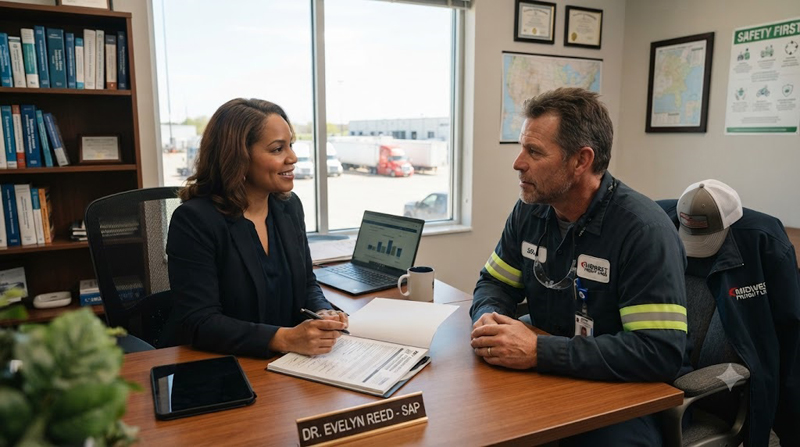
When the auditor arrives, you are not alone.
The difference that shows up on audit day
Ask a carrier what they want from a TPA and they will say fast results. Ask one who has been through an FMCSA compliance review and they will say something else: somebody who knows the rules sitting next to me while the investigator works through my files.
That is what we do. It is also the single most common reason our clients refer us to other carriers.
The findings we see over and over
Drug and alcohol program violations account for a large share of compliance review findings, and they cluster into a short list:
- Random testing rate not met, or selections bunched into one part of the year instead of spread reasonably.
- Missing pre-employment records — no verified negative on file, or no previous-employer testing history for the past three years.
- Clearinghouse queries not run, particularly the annual query on current drivers.
- No supervisor training documentation for reasonable-suspicion determinations.
- No written policy, or a policy never distributed to and acknowledged by employees.
- Post-accident tests not performed, and no written record explaining why not.
- Records not retained for the required period, or held only by a former TPA who is no longer returning calls.
Note the pattern. Almost none of these are about drug use. They are about paperwork, timing and proof. A fleet with a spotless testing record can still fail on documentation — which is good news, because documentation is fixable in advance.
Mock audits: find it before they do
A mock audit is the same review an investigator would run, conducted by us, with no consequences attached. We pull a sample of drivers and trace every record they should have: pre-employment result, previous-employer request, Clearinghouse queries, random selections and completions, any post-accident documentation, policy acknowledgement and training records.
You get a written gap report ranked by severity, with a remediation plan and a realistic timeline. Then we fix what can be fixed and document what cannot.
New entrant safety audits
New carriers face a safety audit within the first months of operation, and the drug and alcohol program is a standard part of it. New entrants fail this more often than experienced carriers do, because nobody told them a consortium membership, a written policy and supervisor training were expected from day one. If you are new, start here — it is far cheaper than remediation.
On the day
We help you assemble the record package in advance, review it with you before submission, and attend the audit. When the investigator asks why a particular selection was not completed in Q3, someone who knows the answer is in the room. That is the whole proposition.
Records from a previous TPA
Switching administrators does not transfer your obligation to produce records. If your former TPA has gone quiet, tell us early — retrieving and reconstructing historic records takes time, and audit day is not when you want to find out they are gone.
Book a mock audit
Prepared, not surprised
Full gap analysis
Mock audit
Remediation
Record assembly
Attendance on the day
New entrant preparation
Compliance Audits — your questions
Common triggers include a poor safety rating or CSA scores, a serious crash, a complaint, being a new entrant carrier, or random selection. You rarely get long notice, which is why preparation has to happen in advance.
Typically your written policy and proof of distribution, pre-employment results and previous-employer requests, random selection records and completion evidence, Clearinghouse query and reporting records, post-accident documentation, supervisor training records, and any SAP or return-to-duty documentation.
A rehearsal of the real review, run by IPS against a sample of your drivers, with a written gap report and remediation plan at the end. It is the cheapest way to find out what an investigator would find.
Yes. An IPS compliance specialist sits with you through the drug and alcohol portion of the review. Clients consistently name this as the reason they stay with us and the reason they refer other carriers.
Tell us immediately. Reconstructing historic records — lab confirmations, selection logs, query history — takes time, and there are established routes to obtain much of it. Starting the week before an audit is not one of them.
At minimum: a written drug and alcohol policy distributed to employees, membership in a compliant random pool, Clearinghouse registration with a C/TPA designated, pre-employment testing records for every driver, and documented supervisor reasonable-suspicion training. We set all of it up as one package.
Still have a question? Call 248-526-9000 or send us a message.
Services that pair with this one

Random Consortium

FMCSA Clearinghouse

DOT Policy Writing