Workplace testing built around your policy, not a rulebook.
Non-DOT testing gives you options — and responsibility
Once you step outside DOT authority, the federal procedural rules no longer dictate your program. You choose the substances screened, the specimen type, the cut-off levels and what a positive result means for employment. That freedom is useful. It also means your written policy is the only thing standing between you and a wrongful-termination claim.
IPS builds non-DOT programs the same way we build DOT ones: documented, consistent and repeatable. Same collection network, same certified laboratories, same Medical Review Officer — just written to your rules instead of the government's.
Keep the two programs separate. A non-DOT result must never be recorded on a DOT chain-of-custody form, and a DOT test cannot be expanded to cover extra substances. Where an employee sits in both categories, we run two clearly separated programs under one account.
Choose the panel that fits the risk
Most employers start with a 5-panel and expand once they see what turns up locally. Common configurations:
| Panel | Typically covers | Best for |
|---|---|---|
| 5-panel | THC, cocaine, opiates, amphetamines, PCP | General workforce screening |
| 10-panel | 5-panel plus barbiturates, benzodiazepines, methadone, propoxyphene, methaqualone | Safety-sensitive and equipment roles |
| 12-panel+ | 10-panel plus expanded opiates, oxycodone, fentanyl and synthetic screens | Healthcare, high-risk and post-incident |
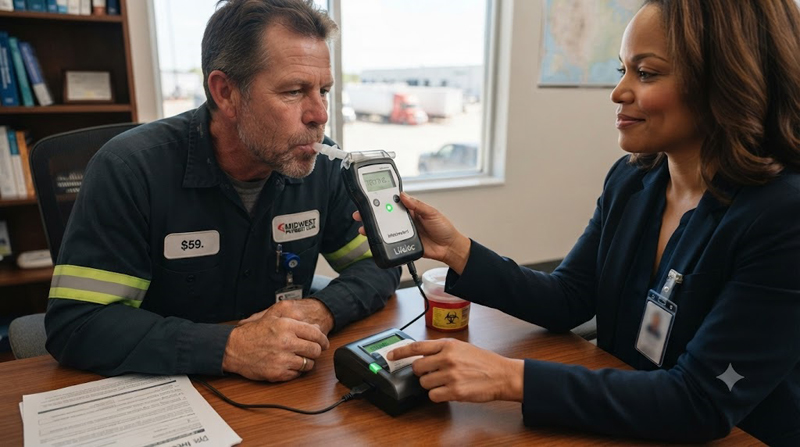
| Alcohol | Breath or EtG | Post-incident and reasonable suspicion |
Specimen types, and when each earns its place
- Urine — the workhorse. Broadest defensibility, widest lab support, detection window of roughly one to several days depending on the substance.
- Hair — roughly a 90-day lookback. Strong for pre-employment when you want a pattern of use rather than a snapshot, weak for recent use.
- Oral fluid — observed collection with no privacy facility needed, and a short window that makes it well suited to post-incident and reasonable suspicion testing.
- Rapid / point-of-collection — negatives in minutes on site. Any non-negative must go to the laboratory for confirmation before you act on it.
Who typically runs a non-DOT program with us
Construction and skilled trades. Manufacturing and warehousing. Healthcare and staffing agencies. Municipalities. Non-CDL delivery fleets and the office side of trucking companies that already run DOT testing with us. If your insurer, your general contractor or your customer contract requires a testing program, we can build one that satisfies the requirement and produces the certificate to prove it.
Where employers get caught out
Three failures cause almost every non-DOT dispute we see:
- No written policy, or a policy that has not been distributed and acknowledged in writing by employees.
- Inconsistent application — testing one employee after an incident and not another in the same circumstances.
- Acting on an unconfirmed screen — terminating on a rapid non-negative before the laboratory confirmation and MRO review come back.
Build a non-DOT program
A defensible program, not just a test
Custom panel design
Policy drafting & review
Rapid results on site
MRO verification
Consistent administration
One account, both programs
Non-DOT Testing — your questions
DOT testing is federally mandated and follows 49 CFR Part 40 exactly — fixed panel, fixed procedures, fixed consequences. Non-DOT testing is governed by your own written policy: you choose the panel, the specimen type, the cut-offs and what happens after a positive. The collection and laboratory process can look similar, but the paperwork must be kept entirely separate.
Yes — in a non-DOT program. You can screen for benzodiazepines, barbiturates, methadone, fentanyl, synthetic cannabinoids and more. What you cannot do is add those substances to a DOT test or record them on a DOT chain-of-custody form.
Practically, yes. Some states and many insurance and contract requirements make it mandatory, and without a distributed, acknowledged policy you have very little defence if a termination is challenged. We draft the policy as part of setting up your program.
A rapid negative is generally fine to accept. A rapid non-negative is only a screen — it must be sent to a laboratory for confirmation and reviewed by an MRO before you take any employment action. Acting on an unconfirmed screen is the single most common non-DOT mistake we see.
Yes, in a non-DOT program. Hair gives roughly a 90-day detection window, which makes it useful for identifying a pattern of use rather than a single recent episode. It is poor at detecting use in the last few days, so many employers pair it with a urine screen.
Still have a question? Call 248-526-9000 or send us a message.
Services that pair with this one

Pre-Employment
Breath Alcohol Testing

Medical Review Officer